BAR OPERATIONS
Introduction and definition
Bar is defined as a counter where goods and services of a specified kind are sold and
dispensed. Specifically in hospitality industry, it is defined as a counter where food and/or
beverages are sold and provided. Thus, there are food bars as well as beverage bars.
Food bars include Oyster bars, Snack bars, Sandwich bars etc. However, in food and
beverage business, the term 'bar' invariably mean the beverage bars - particularly the
ones that serve alcohol.
The, term 'bar' connoted as a counter for dispensing goods and services
Classification of bar:
Bars can be classified in various ways. It may be classified on the basis of its function;
architectural concepts, themes, interiors and ambience: patronizing clientele: key
beverage (product) served; location; payment of drinks; in-situ (on-premises)
entertainment offered, etc. However, noteworthy point is that a certain type of bar may fit
more than one classification.
1) ON THE BASIS OF FUNCTION
On the basis of function bars may be classified into:
i. Front Bars: These are also called as public bars. They are situated in front of the
house and are characterized by barman-guest contact, facilitating maximum
interaction. Here, bartenders serve the public face to face. Some guests are seated
and served at the bar counter itself while others purchase drinks at the bar counter
and consume standing or carry them to the tables provided. Basic front bars offer
adequate bar skills, beverage lists, comfort, decor and ambience. It gets upmarket,
stylish, and more lavish, focused (specialized) and more expensive as it evolves
into lounge bars and cocktail bars. Front bars may or may not provide
entertainment.
ii. Service Bars: These are also called as dispense bars. Here, bartenders do not
serve the public directly but pour drinks that are picked up by servers and delivered
to customers at different locations like the guestroom, a table in the restaurant or
a poolside deck chair. In short, it fills drink orders brought by waiters and
waitresses only. Generally in such bars, a single pouring station is enough to
handle the volume. Also, guests have no access to service bars and hence are
characterized by absence of barman-guest interaction. However, service bars
need the same forethought in its planning, has the same functions. Uses the same
equipments and performs the same tasks of recording and controlling the pouring
& selling of drinks as any other bar. It is of two basic types:
PARTS OF THE BAR
Typical bar is made up of three parts:
The Front Bar, the Backbar and the Underbar Often it may have a
fourth part - the Overbar. Each part has its special functions The figure shows all these three parts in profile
with its standard dimensions. The length of the bar will vary according to need.
i. THE FRONT BAR: Customers order their drinks and these drinks are served at the Front Bar. Thus,
front bar is also called the Customers' area. It is typically 16 to 18 inches wide with an alcohol-proof
and waterproof top surface, usually made of laminated plastic. An often padded armrest runs along
the front edge. It is usually 13 inches wide. Thus, the total width of front bar is 24-26 inches, The
last few inches of the back edge of the front bar are usually recessed, and the bartender pours the
drinks here, to demonstrate liquor (well or call) brand and pouring skill. This recessed area is known
by various names like rail, glass rail, drip rail, or spill trough
ii. Service Bars: These are also called as dispense bars. Here, bartenders do not
serve the public directly but pour drinks that are picked up by servers and delivered
to customers at different locations like the guestroom, a table in the restaurant or
a poolside deck chair. In short, it fills drink orders brought by waiters and
waitresses only. Generally in such bars, a single pouring station is enough to
handle the volume. Also, guests have no access to service bars and hence are
characterized by absence of barman-guest interaction. However, service bars
need the same forethought in its planning, has the same functions. Uses the same
equipments and performs the same tasks of recording and controlling the pouring
& selling of drinks as any other bar. It is of two basic types:
a) Back-of-the-house service bars: As the name suggests these are located
behind the scenes and hence hidden from guest view. They are smaller and
simpler in design. Backbar of such bars have a room for bulk supplies of beer,
mixes, liquor stock, etc and has no display. These bars do not require hiding of
ugly and noisy equipments and mechanical dispensing systems are often used
to increase speed and reduce liquor loss. These bars act as centralized bar
dispensing drinks in various guest service areas like various kinds of outlets,
guest- rooms, poolside etc. and thus centrally located in a hotel. It does away
with the problem of having separate bars thus maximizing the service area of
various outlets.
b) Front-of-the-house service bars: As the name suggests these bars are in full
view of the guests but used only for dispensing beverages to the servers
against guest's orders. These bars are less usual, are generally found in
conjunction with food service and are a part of the dining room. These bars
must harmonize well with the overall ambience and due thought should be
given to its layout, design and decor for efficiency and economy of service.
The
emphasis is more on functional ambience and is not lavishly equipped as a fullscale public or cocktail bar.
iii. Special Function Bars: As the name suggests these bars are used for beverage
sales and service at functions like banquets, meetings, receptions, conferences or
conventions. It can also be used In recreational areas like golf course and tennis
courts, open gardens & pools side or anywhere else in the hotel. It is of two basic
types:
a) Portable bars: It takes the form of mobile trolleys (on castors/wheels) built to
specifications. These mobile trolleys are parked in a suitable area when not in
use.
b) Crash bars: These are a make-shift arrangement of trestle tables (horizontal
tables held by two pairs of collapsible legs that save space when stored) nested
together and dressed up to create a low and open bar counter. Crash bars are
more versatile as they can be arranged into any shape or size required and can
also be made to harmonize with the decor and ambience of the function. After
the function is over, these tables are dismantled and stacked away.
iv. Minibars: They are also called as in-house bars or honour bars. It is a relatively
new concept and consists of a refrigerated cabinet placed in a guest room along
with the menu cum rate-list, for consumption by room-guest. Thus, these bars are
means of visual merchandising to boost beverage sales. By this option, the guest can enjoy the drink in the privacy of the room.
2) ON THE BASIS OF ARCHITECTURAL CONCERTS, THEMES, INTERIORS AND
AMBIENCE
On the basis of architectural concepts, themes, interiors and ambience, bars can be
classified into:
i. Cocktail Lounges: Cocktail lounges are more comfortably furnished, more
luxurious in ambience and more expensive than public bars. Thus, it is an
enhanced version of public bars. Seating includes chairs with armrests or
sofas/couches and coffee tables are spaciously laid out. The ambience is
particularly relaxing with enhanced elegance and style. Entertainment may be in
form of live music (like Guitarist, Pianist, etc) and some cocktail lounges may be
themed.
Such bars have a comprehensive beverage list and also serve
complimentary light snacks with the drinks. Guests use these lounges for a
'sundowner' in the evening or for an aperitif before proceeding to an in-house
restaurant for dinner. Overcrowding, standup consumption and very high
turnovers are not encouraged in bars. Sometimes, there may be a cocktail lounge
on privileged floors for the exclusive use of guests staying on these floors.
ii. Sunken Bars: As the name suggests, these bars are sunk (immersed) and
surrounded by water on all sides i.e. it is built in the middle of a swimming pool.
These bars are usually found in resort hotels where guests spend a lot of time in
and around the pool. Here, guests swim to the bar to collect the drinks and
consume it seating at Immersed bar stools or on air floats.
iii. Tiki Bars: As the name suggests, these bars are themed on the tiki culture i.e. a
South Seas-inspired pop culture in United States. This culture was at its height in
the 1950s and 60s, and is enjoying a revival now-a-days. Tiki bars are generally
made of bamboos, canes, straw mats etc and are decorated with tropical flowers
including orchids, fruits, etc. They dispense rum based cocktails and mixed drinks
such as zombie, planters punch etc.
Pubs: Also referred to as dive or neighborhood bar in America, it is a contracted
form of 'Public House' - a licensed house for the sale and consumption of alcoholic
drinks on or of the premises. These are small outlets - pretty much like local places
at the comers; very basic, nothing fantastic or special and generally run of the mill
bars. They dispense common beers, standard spirits and wines.
3. ON THE BASIS OF PATRONIZING CLIENTELE
On the basis of patronizing clientele, bars can be classified into:
i. Meet Bars: Also called as "singles bars", they are patronized by individuals looking
for a new friend of the opposite sex for a date to a complete relationship. These
individuals stay long enough to meet someone they did like to spend the evening
with, and then move on to a suitable place for food, entertainment and leisurely
evening together.
ii. Ladies (Only) Bars: As the name suggests, these bars are patronized by members
of female sex only (permanently as opposed to bars having an occasional ladies'
night) and tend to be psychologically safer. Men are strictly not allowed in such
bars. They generally dispense ladies' drinks like cocktails, gin, vodka, wines, etc.
They are popular as the females feel secured as opposed to a regular male
dominated bar However, too many ladies bars are not likely to succeed in a single
area.
iii. Gay/Lesbian Bars: As the name suggests, these bars are patronized by gay
individuals looking out for a partner. On the other hand, ladies only bar doubles up
as Lesbian bars also.
4. ON THE BASIS OF KEY PRODUCT (BEVERAGE) SERVED
On the basis of principal beverage sold, bars can be classified into:
i. Wine Bars: As the name suggests, such bars serve a wide range of wines by
glass/carafe/bottle and wine based mixed drinks. Food served include cheese
trays, fruit platters and hors d'oeuvre specialties. Wine list consists of a wide variety
of wines ranging from inexpensive house wines to quality wines at dizzy prices for
accommodating different tastes and budgets. Wine bars are declining as serving
only wine limits the clientele to wine-lovers only. Also, purchasing appropriate
wines requires expertise and large investment.
Hence, such bars feature a limited
range of beer and spirits to maintain a broad appeal and realizing good profit
margin. In stark reality, now-a-days these are simply bars that have a wine oriented
ambience and often broaden their offerings by serving meals. Wine bars may also
be successfully combined with a smart casual restaurant. Also, it requires
professional, knowledgeable staff that comes expensive.
ii. Beer Bars: As the name suggests, these bars stock and serve only/predominantly
beer and beer based mixed drinks. They generally carry and sell a variety of
different styles and brands of beer like stout, porter, ales, pilsners, draught etc by
glass/pitcher/pint/can/bottle. Many a times, such bars are owned/franchised by
brewery companies as part of their vertical marketing integration strategy.
iii. Cocktail Bars: Cocktail bars are full-service bars serving an entire range of
alcoholic and non-alcoholic beverages but specializing in wide range of cocktails
and mixed drinks - both classical and innovative. Here, the focus is on the cocktail
range featured on the menu and the skills & proficiency of the bartender. Cocktail
bars are upmarket beverage outlets, commonly found in luxury hotels and are
luxuriously furnished and lavishly equipped. It carries a complete range of liquors,
garnish, glassware and equipment in order to prepare and serve different cocktails
and other drinks. Such bars can be thematic and sometimes open only in the
evenings offering professional and elegant tray and bar service. Being a high class
and refined bar, standing crowds and congested layouts are unlikely.
iv. Tequila bars: As the name suggests, such bars stock and serve
only/predominantly different styles and brands of tequila and tequila based mixed
drinks.
v. Bloody Mary bars: .As the name suggests such bars serve various styles and
variations of the famous mixed-drink (cocktail) Bloody Mary - a mix of Vodka &
tomato juice. It also stocks all the items and Ingredients going into its making.
5. ON THE BASIS OF PAYMENT OF CONSUMED DRINKS
On the basis of payment of consumed drinks (particularly at bars in banquets/catered
events), bars can be classified into:
i. Host Bars: Also called as Sponsored bars, a host bar is a kind of special function
bar where the total consumption of beverages of any type (from what is available)
and in any quantity by the Invited guests at the function, is charged to and paid for
by the host at the end. Consumption may be recorded and charged on
a. a drink-count basis,
b. bottle count basis
c. per hour basis.
On a drink-count basis of Host Bar, a system is kept to track the number of each
type of drink served through tickets turned over to the bartender by guests,
transactions recorded by a point of sale system, or marks on a tally sheet. The
consumption is then charged generally With reduced rates (as compared to normal
rates) to obtain the host's business. On a bottle-count basis of Host Bar, the entire numbers of bottles used or open is charged upon an agreed price. This is nothing
but difference between the beginning inventory and ending Inventory of each type
of spirit, beer or wine bottles.
Cash Bars: These are also called as No-host bars, Cash on delivery (COD) bars
or A-Ia-carte bars. In some service clubs, some convention functions, and
meetings; such bars are set up. Here, the host may pay for the food and venue
while the individual participants pay for drinks consumed.
iii. Open Bars: In these kind of bars, the guest gets any type and any quantity of drink
desired (limited only by brands and types of merchandise carried) as he has
already prepaid for them in the form of a ticket or pass purchased for the event,
which include food, entertainment as well as beverages. In other words, the bar is
'open' to the guest to consume any liquor available and in any quantity desired.
6. ON THE BASIS OF LOCATION OF BARS IN HOTELS AND OTHER
ESTABLISHMENTS
On the basis of location of bars in hotels and other establishments, bars can be
classified into:
i. Foyer Bars: As the name suggests, such bars are situated in the foyer (lobby area)
of some superior residential hotels and serve drinks in the same area. However,even if there is no such bar, most of the hotels serve drinks to seated guests in the
foyer.
ii. Nightclub & Discotheque Bars: As the name suggests, these bars are found in
nightclubs (An outlet that is principally open at night for dinner, dance and
cabarets. Decor is lavish while service is elaborate. A live band is always there
and most establishments insist on formal wear so as to enhance the atmosphere)
and discotheques (An outlet which is principally meant for dancing to recorded
music.
iii. Airport Bars: As the name suggests, these bars are found on international airports.
They are characterized by offering quick service to transit passengers. They are
often economically priced because of access to duty-free liquor. It is posh.
iv. Casino Bars: As the name suggests, these bars are found in casinos. They offer
gambling and gaming services as well.
LARGE UNDERBAR AND BACKBAR EQUIPMENTS
1) EQUIPMENTS FOR MIXING DRINKS
The main equipment for mixing drinks IS the POURING STATION. It is known by
various names like cocktail station, cocktail unit, beverage center or jockey box. It is
outfitted with the following equipments:
i. Ice chest (ice bin): Considered as centerpiece of any pouring station, it is usually
30 inches long with sliding or removable doors. Sometimes, it comes with a divider;
enabling two types of ice to be stored i.e. cube ice and crushed ice.
ii. Bottle Rails or Speed Rails: The front of the station consists of a 3.5 feet bottle rail
(speed rail) with a shorter hang-on rail on the front. Sometimes, there is a double
rail on the hand sink as well. Speed rail contains the most frequently used (poured)
liquors. Usually, well brands (brands the house pours when a drink is ordered by
type rather than by name) and popular call brands (brands customers ask for by
name) are setup within easy reach in the speed rails.
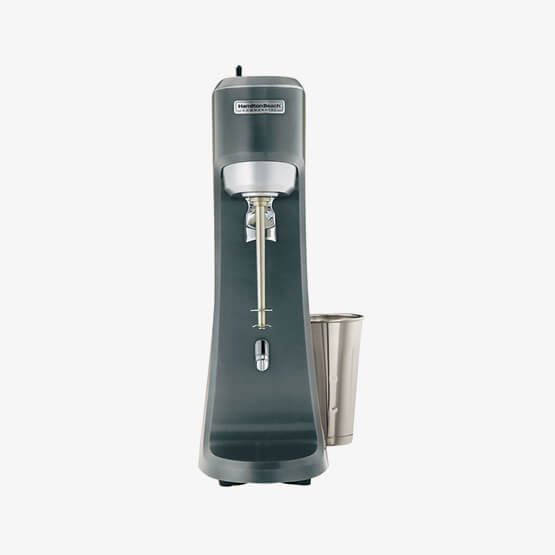
iii. Mixer and Blender: Mixer and Blender are located on a recessed shelf on the
righthand side of the cocktail unit. The shake mixer (spindle blender) has a shaft
coming down from the top that agitates the contents of its cup. It is a mechanical
substitute for a hand shaker.

(SPEED RAIL )
(BLENDERS )

( MIXERS)
3. OTHER LARGE EQUIPMENTS
i. Glass Froster: Usually, a glass froster is used to chill glasses for straight-up
cocktails, frozen drinks and ice cream drinks. It is a top-opening freezer that chills
glasses at O·F temperature. Always dry glasses and mugs should be placed in the
froster, otherwise a thin coat of ice will form on the glass and the glass may stick
to the lip of the drinker. Alternatively, a refrigerator will frost a wet glass without
making ice. Other alternative is to ice the glass by hand with ice cubes just before
the drink is poured.
ii. Automatic Glass-Washer: For better cleanliness, stricter sanitation laws and labor
savings, automatic glass-washers are used now-a-days. It is an alternative to
washing glasses by hand. An underbar or backbar rotary glass-washer easily
washes up to 500 glasses per hour, giving bartenders more time to prepare drinks.
It washes and rinses glasses with tap water, provides a final high temperature rinse
(120·F to 160· F) with good chemicals to sanitize them and blow dries them without
water-spots.
SMALL BAR TOOLS AND EQUIPMENTS
All small bar tools and equipments are usually made of stainless steel as it looks good, is
long-lasting, durable and can be cleaned easily. Small bar tools and equipments are used
for mixing and pouring, preparing condiments to garnish drinks, and for serving.
1. SMALL WARES FOR MIXING AND POURING :
i. Jiggers A jigger is a measure of ounces or fractions of ounces. It is used to
measure liquors for cocktails, highballs and other mixed drinks.
There are two
types of jigger
ii. Mixing glass: It is a heavy glass container having a capacity of 16 to 17 ounces, in
which drink ingredients are stirred together with ice. It is used to make Martinis and
Manhattans and other drinks whose ingredients blend together readily. It is rinsed
after each use. Mixing glasses should be heat-treated and chip-proof,
iii. Hand shaker: It is a combination of a mixing glass and a stainless-steel container
that fits on top, on an angle so that one edge is flush with the side of the glass. It
is also called as Boston's Shaker. Usually, it has its own strainer. The stainlesssteel container is known by varied names like mixing cup, mixing steel, mix can
etc. It is used for shaking drink ingredients with ice and is used in making of
cocktails with fruit juices, egg, sugar, cream, or any other ingredient that does not
mix readily with spirits. It is rinsed after each use.
iv. Shake mixer: it is an automatic alternative of a hand shaker and is faster and more
efficient. it can even make ice-cream drinks, which the hand shakers can't do·, The
mixing container of the shake mixer is also called a mixing cup, steel, or can.
v. Bar strainer: It is a round wire spring on a handle. It comes with ears that fit over
the rim of a shaker or mixing glass and keeps ice and fruit pulp from going into the
glass when the drink is poured. The most famous one is the Hawthorn Strainer.
vi. Barspoon: It is a stainless steel shallow spoon with a long handle and a bead on
the end. It is 10 to 11 inches long. The bowl equals a teaspoon. Bar-spoons are
used for stirring drinks in a drink glass or mixing glass or cup.
vii. Ice scoop: It is an implement for scooping ice from the ice bin. It has a capacity of
6 to 8 ounces. It makes easy to get the right amount of ice with one swoop of the
scoop. Glasses should not be used for scooping ice.
viii. Ice tongs: They are designed to handle one cube of ice at a time. They serve an
important function of hygiene, as hands should never touch the ic3 c a that goes
into a drink.
ix. Muddler: or muddling stick: It is a wooden tool that looks like a little baseball bat.
One end is flat for crushing one substance into another. For instance: sugar
crushed into bitters in an Old-Fashioned. The other end is rounded and can be
used to crack ice.
x. Funnels: They are needed in several sizes for pouring from large containers into
small ones. For instance: transferring special mixes from bulk containers into
plastic bottles for bar use. Some funnels have a screen at the wide end to strain
out pips and pulp.
xi. Fruit Squeezer: A bar-type fruit squeezer is a hand-size gadget that squeezes half
a lemon or lime for a single drink, straining out pits and pulp,
xii. Glass Rimmer: It is a gadget used to rim a glass with salt or sugar, It is made up
of three trays. One contains a sponge that is saturated with lemon or lime Juice,
the second contains a layer of salt, and the third a layer of sugar. The glass rim is
pressed on the sponge, and then dipped in salt (for a Margarita or a Salty Dog) or
sugar (for a Side Car).
BAR PREPARATION :
Bar opening duties include:
completing the requisition for bar stocks for the day's trading (business):
carrying out housekeeping duties:
cleaning one area of the bar shelves thoroughly on each day of the week, so that
over the seven-day period every part of the bar receives attention:
requisitioning food items which are required from the stores:
wiping and polishing bar arid table tops where appropriate;
collecting dean linen before service;
restocking the shelves in the bar behind the bottles which are already there; labels
should always face the customer with each bottle wiped clean as it is put in place;
old stock is put in front of the new stock;
checking that an adequate supply of ice is available;
checking the cash float
laying out cocktail equipment where needed; checking that optics are in working
order;
attending to the beer casks in the cellar and turning on the beer taps; a small
sample of each beer should be tasted;
polishing the glassware.
Bar closing duties include:
checking and clearing the tills;
completing bar summary sheet;
removing empty bottles from the bar;
attending to the beer casks in the cellar and turn off the beer taps;
collecting all glasses and ashtrays from the bar tables;
brushing out the ashtrays into a metal bin with a 2'/2 - 3 inch paintbrush;
making the bar ready for early cleaning the next morning by placing the chairs on
the tables;
starting a requisition list of known items of stock which will be required the next
day; the list will be completed by the next day's opening team;
washing all glassware;
returning useable fruit to the fridge;
disconnecting electrical equipment, except for tills and refrigeration or cooling
cabinets, by removing the plugs from the sockets;
pulling down and securing all grills, hatches and windows.
BAR THEFT & FRAUD
Although bar and beverage control may be more accurate and successful than food
control; bar thefts and frauds inevitably occur. Some are standard and universal while
others are situation based, Some of them are bar billing frauds while others are frauds by
manipulating the liquor being served, Of course billing frauds are prevalent in restaurant
operations as well, but occur more frequently in a bar owing to the barman himself
doubling as the cashier, the relatively more informal attitude of the guest, the trust he
places in the barman, an inability to maintain an accurate drink count and his own state
of insobriety which makes him pay cash on demand for the drink without asking for the
cheque/bill and without checking the bill if one is offered, The existing control system and
the manner in which cash is collected in the bar could proude for loopholes leading to
theft of money.
Keeping a separate cashier and barman may not solve plug the loopholes
if there is a collusion between the two, and in order not to allow a nexus to proliferate,
bars employing more than one cashier have a policy of rotating the shifts of their cashiers
and in. hotels having several outlets, a different cashier is assigned to the bar each-week
I fortnight. There are several frauds that can be perpetrated with cash registers in a bar.
However, higher degree of automation and the inclusion of an audit (till) roll may trace
them and help to minimize some of them, While on the topic of billing frauds It must be
mentioned that actions on part of the guest such as paying only against a bill checking
the same, and Insisting on a paid copy of the bill have an important role in discovering
and controlling billing frauds, It is not uncommon to find the words 'This is not a bill" printed
across a totaling slip or KOT to enlighten the guest against possible fraud.
Why are bar frauds widespread?
Bar thefts and frauds are widespread because of the following reasons:
a) Personnel handling cash (like bartenders, cashiers, service staff, etc) often hold
low-paid, entry-level positions. Moreover, these employees frequently move from
job to job and have little identification/loyalty to a property.
b) The busy environment and the complexity of production/service tasks provide the
opportunity to personnel in such beverage operations to take advantage of
loopholes in income control systems and provide ample scope to dishonest
bartenders to perpetrate frauds.
c) To some extent, many managers are simply apathetic about employee thefts and
frauds. Some feel that theft is inevitable and simply increase prices to cover It.
BAR THEFTS & FRAUDS
Dishonest bar staff (attempt to) steal sales revenue in many ways.
The different ways by
which the employees steal (revenue and liquor) and precautions that the management
can take to reduce the possibility of theft and hence frauds are given sequentially hereby
BEVERAGE (LIQUOR) RELATED THEFT AND FRAUD
These thefts and frauds are generally due to manipulation of quantity, quality or source
of liquor by the bartender or beverage servers (waiters).
i. Underpouring:
Also called shortpouring, it is pouring a measure lesser than what has been
ordered by a guest. (e.g. If a bar man underpours- five drinks by one sixth the
normal measure, it results in an excess which can be sold as a sixth drink. Here,
the sale of sixth drink is not recorded and the resulting cash payment is pocketed.)
This fraud does not affect the beverage cost percentage. Underpourinq alcohol in
mixed drinks is widespread and goes unnoticed because it is pre-mixed when
served. Sometimes, underpouring is resorted to compensate for shortages caused
by overpouring.
Precaution: Bartenders should be told to prepare aI/ drinks using a peg measure
and not to free pour under any circumstances; Other solutions include a policy of
pouring in full guest view wherever possible, use of bar optics (pourers) fitted to
bottles that deliver an exact measure of liquor, the use of automatic drink
dispensing systems, and use of shoppers to regularly observe and report on this
fraud. Moreover, bartenders should not be allowed to use their own measuring
devices to avoid this fraud.
ii. Dilution:
Diluting liquor (like gin, vodka, white rum, silver tequila, etc which are colourless)
and pocketing income from the additional drinks sold is called Dilution. Further, if
this liquor is used in cocktails it is unlikely that the guest will notice minor changes
in taste. Dilution is resorted to compensate for shortages caused by overpouring.
Precaution: Use shoppers to regularly watch the bartenders and investigate
frequent guest complaints about the strength of the liquor. Bottles may be checked
as some liquors turn cloudy when water or soda are added other liquors turn a
lighter colour. One way pourers in the neck of the bottle are other way of preventing
dilution. Density checks with the help of a hydrometer may be performed if dilution
is suspected and compared with its original density.
iii. Bringing in personal bottles:
Also called the Phantom bottle fraud, bartenders serve drinks from these bottles
when the guests order matches with the nature/brand of liquor brought in by them.
The sale is not billed and the cash is pocketed. This fraud does not affect the
inventory levels nor the beverage cost percentage but results in severe loss of
revenue to the organization.
Precaution: Marking/identifying hotel bottles in a unique and hard to duplicate
manner (like stamping) and regular visual inspection helps to eliminate this
practice. Keep bottle stamps secure (e.g. in a safe) so that employees cannot
misuse them. Another that could be used along with stamping is to break all empty
its contents into an empty liquor bottle that has the property stamp.
iv. Substitution:
Serving a lower quality brand when guests order for call brand & billing the guest
for the expensive call brand, thus pocketing the extra cash is called substitution.
Some bartenders even fill an empty call brand bottle with house brand. In this case,even guests seated at the front bar will not suspect that a wrong brand is being
served. Here, the inventory may reveal a shortage if the stock of each liquor is
listed and maintained separately. To cover up, the bartender may resort to leveling
off the shortage by dilution, short-pouring, or adulteration by adding similar liquor
(of some other brand).
Precaution: Bartenders and bar-servers should be made to write all drink orders
on a BOT, which is billed by a separate cashier. Having a separate cashier is
desirable as it makes the billing function independent of the liquor service function
which facilitates control. An alternative method is to write all drink orders onto a
check and having the bartender ring up the amount on the guest bill before serving
the drink, thereby Charging the guest the right amount (and denying the bartender
any excess).
v. Using personal drink measuring devices:
Aiding in underpouring, these personal drink measures (invariably of a lower
volume) help obtaining excess liquor, selling the same and pocketing the excess
cash. Guests do not suspect as liquor is filled to the brim before being dispensed
into the glass and they would never doubt that the volume of the peg measure itself
is faulty.
Precaution: Routinely check the portion control tools (peg-measures, pourers, etc)
and the bartenders should be made to use only the tools provided by the facility.
(In India, standard measures may be purchased from shops approved by the
Government under the Weights and Measures Act).
vi. Selling drinks for cash and recording them as spilled, accident, returned, walk-out
or complimentary:
It helps in pocketing the money that results from the sale. Sometimes, staff collects
the beer from undrained bottles and glasses to fill a full bottle, designated it as a
flat beer and claim a replacement In exchange. It is then sold and the proceeds
are pocketed or simply drunk by the bartender.
Precaution: Bartenders should not be authorized to give out free drinks and any
complementary drink must first be authorized by somebody in authority. Any
returned drinks and requests for replacements must be approved by management.
Also, accidents must be evidenced by the service staff and approved by the
management (like showing the crown intact neck of a beer) before a replacement
is given. To avoid frauds like building the bottle, close supervision of table
clearance, introduction of a policy of removal of the used beer bottles to the pantry
area where they will be stacked in an inverted manner, and the immediate
clearance of all glasses to the wash-up area for washing.
vii. Misuse of "one full against one empty bottle" policy:
In hotels/restaurants that have a system of issuing one full against one empty
bottle; bar personnel may bring in empty bottles from out and exchange for full
bottles from the hotel store/cellar. Consequently; drinks from bottles are sold and
the cash pocketed. It results in a sharp difference of the beverage cost as the bottle
cost is incurred by the hotel without a corresponding increase in its revenue.
Precaution: Having an established par stock and random checking of this par stock
is recommended so that the fraud is avoided. But a better precaution is to stamp
the purchased bottles with signature of the cellarman or special identifying label or
special sticker or a rubber stamp to which only authorised personnel have access.
Comparing standard beverage costs to achieved beverage costs periodically may
eliminate this kind of fraud.
viii. Overpourinq:
Bartenders do so to influence the guest for a larger tip or buy them (bartenders) a
drink.
Precaution: Bartenders should be told to prepare all drinks using a peg measure
and not to free pour under any circumstances. Other solutions include use of bar
optics (pourers) fitted to bottles that deliver an exact measure of liquor, the use of
automatic drink dispensing systems, and use of shoppers to regularly observe and
report on this fraud. Moreover, bartenders should not be allowed to use their own
measuring devices to avoid this fraud.