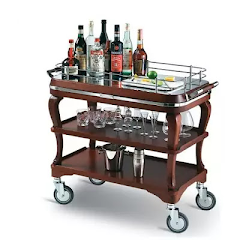
BANQUETS
A banquet is a large meal or feast,
complete with main courses
and desserts.
It usually serves a purpose such as a
charitable gathering, a ceremony, or a celebration,
and is often preceded or followed by speeches
in honour of someone. The idea of banqueting is ancient (see Sellisternium,
Belshazzar's
Feast, and Mead halls)
In the sixteenth century
a banquet was very different from our modern perception and stems from the medieval
'ceremony of the void'. After dinner the guests would stand and drink sweet
wine and
spices while
the table was cleared, or ‘voided’ (Later in the seventeenth century ‘void’
would be replaced with the French ‘dessert’). During the sixteenth century,
guests would no longer stand
in the great chamber whilst the table was cleared and the room prepared for
entertainment, but would retire to the parlour or banqueting room. As the idea
of banqueting developed, it could take place at any time during the day and have
much more in common with the later practice of taking tea. Banqueting rooms
varied greatly from house to house, but were generally on an intimate scale
either in a garden room or inside such as the small banqueting turrets in Longleat House. Today banquets serve many purposes from training sessions, to formal
business dinners. Business banquets are a popular way to strengthen bonds
between businessmen and their partners. It is common that a banquet is
organized at the end of an academic conference. Aluau is
one variety of banquets originally used in Hawaii. The Nei Mongol
provincial government in China levies a tax on banquets.
History of Catering
Most people have been to an event that was catered by a professional
catering company.
Catering
enters peoples’ lives during some of their most important times: weddings, baby
showers and anniversary parties, just to name a few. Have you ever wondered
just when catering actually started? Catering can be traced back to the 4th
millennium BC in China. During this time in China as well as in Ancient Egypt,
Greece and the prosperous times of the Roman Empire, catering was used to
provide food for soldiers on transportation and trade routes. It was also
critical in the Christian Pilgrimages to Rome and other travelers throughout
Europe. During the Middle Ages catering spread throughout Europe and evolved
into not only providing food for soldiers and travelers but for entertainment
purposes for the upper classes. Catering and foodservice became so popular in
the 14th and 15th century that Germany was the first country to put laws in
place regulating quality of both food and beer.
Catering continued to flourish and in the mid 1800’s Alexis Soyer invented the first catering
boiler which used steam to help keep food warm. During the 19th and 20th
century many more technical innovations, improvements in transportation, and
growing populations helped catering become an important part of the national economy. Today’s catering has
evolved from simply providing food for travelers. Catering companies now
pride themselves on not only providing appetizing food but also a visually
appealing atmosphere, from the presentation of food to linens and decorations.
Although the intent of catering has changed throughout the years, it continues
to be a vital part of our society.
Progress of Catering and Banquet
Events range from cheese lunch drop-off to full-service catering. Caterers
and their staff are part of the food service industry. When most people refer to a
"caterer", they are referring to an event caterer who serves food with
waiting staff at dining tables or sets up a self-serve buffet.
The food may be prepared onsite, i.e., made completely at the event, or the
caterer may choose to bring prepared food and put the finishing touches on once
it arrives. The event caterer staffs are not responsible for preparing the food
but often help set up the dining area. This service is typically provided at banquets,
conventions,
and weddings.
Any event where all who attend are provided with food and drinks or
sometimes only hors d'oeuvres is often called a catered
event.
Many events require working with an entire theme or color scheme. A
catering company or specialist is expected to know how to prepare food and to
make it attractive. As such, certain catering companies have moved toward a
full-service business model commonly associated with event planners. They
take charge of not only food preparation but also decorations, such as table settings
and lighting. The trend is towards satisfying all the clients senses with
food as a focal point. With the correct atmosphere, professional event caterers
with experience can make an event special and memorable. Beautifully prepared
food alone can appeal to the senses of taste, smell, and sight - perhaps even touch,
but the decorations and ambiance can play a significant part in a successfully
catered event. Catering is often sold on a per-person basis, meaning that there
is a flat price for each additional person. However, things like lighting and
fire permits are not scaled with the guest count, so per-person pricing is not
always appropriate. It is necessary to keep the cost of the food and supplies below
a price margin in
order to make a profit on the catering.
As many others in the food service industry, caterers and their staff work
long hours. It is not uncommon for them to work on holidays or 7 days a week
during holiday event seasons.
A comprehensive, formal full-service catering proposal is likely to include
the following time-line matters:
Rental arrival time
Staff arrival time
Bar open time
Meal serve time
Bar close time
Rental pickup
Out-of-venue time Each of these factors affects the catering price. For
example, a rental quote for an "anytime" weekday delivery is usually
much more economical than an "exact-time" delivery.
General menu considerations:
Clients may have specific dietary or religious needs to consider. these include
Halal,Kosher,Vegetarian,Vegan and food allergy requests. Increasingly, clients are
interested in food sustainability and food safety.
Hors d'oeuvres: it should be clear if these are passed or stationary. Most
caterers agree that three or four passed items are appropriate for the one-hour
period prior to a meal.
Meal Rentals: May include tables, chairs, dance floor, plants, tabletop
(china, flatware, glassware, linens, chargers), bar glassware, serving
equipment, salt/peppers, etc. It should be clear whether table and chair setup
and take-down is included. Most rental companies do not automatically include
setup and take-down in the rental charges.
Labor: varies from caterer to caterer, but generally speaking, an event
will have a Lead/Captain/Event Manager, a Chef, perhaps a Sous Chef or Kitchen
Assistant, Wait staff and Bartenders. The labour on a plated dinner is
generally much higher than the labour on a buffet, because a plated dinner
involves double the china, and usually a minimum of three served courses,
plus served coffee. Simply put, there's a lot more to do. To do it properly
requires roughly 10 to 50% more staff. On a large event, this can be
substantial, especially if overtime or double time applies.
Service Charge: Sales Tax, Some quotes will include
lighting, liquor permit, fire permits, draping, florals, valet and coat check.
Many venues discreetly get a "cut" of the catering bill. Caterers are
contractually committed to not disclose this fee specifically in their contracts
with the clients. Therefore, catering will sometimes cost substantially more
atone venue versus another. Also, caterers must compete with illegal operators.
A legitimate caterer will have a business license and a health permit both
showing the address of the place from which they do business. In addition, many
caterers will provide partial catering services in addition to full-service.
Partial catering can include cooking and delivery of prepared foods, pre-cooked
dishes for pickup at the caterer's location, and cooking, delivery and setup
without service. In many cases partial catering can be an excellent and
economical option to full-service catering
Banquets and Outdoor catering
A banquet is a FOOD AND BEVERAGE service at a specific
time and place, to
a given number of people, to an agreed menu and price. Banquets are special
functions for social professional and state occasions.
SOCIAL OCCASIONS: Wedding Receptions, Birthday Parties, Cocktail parties, New Year parties etc.
.

Cocktail

Reception
PROFFESIONAL EVENTS: Conferences,
Convention, Training programs, Board
meetings etc.
STATE AFFAIRS: State banquets, Diplomatic cocktails
and dinners etc.
Banqueting
is a business of selling space to hold functions. Banquets require large halls
with kitchens to provide quantity foods, Banquet halls are found in large
hotels where banquet business is part of the overall revenue strategy
Banquet organization structure
|
|
Banquet manager
|
|
|
Banquet Sales Coordinator
|
|
Banquet Secretary
|
|
Banquet Supervisor
|
|
Banquet Sommelier
|
|
Waiters
|
|
Waiters
|
|
Casual Staff
|
|
Casual Staff
|
The function
book
The
function book is a control register maintained in the banquet office. It
records days and times and nature of events in various function rooms. It is a
reservation dairy to commit dates and venues. The book is now computerized. It
is maintained by the banquet secretary, and is accessible to the Banquet manager and the Sales coordinator. The objective is
to maximize banquet sales as space not sold is revenue lost forever.
Contract of Agreement
A Contract of Agreement is signed
between the banquet management and the
client. It specifies the details required to make the function successful. A
contract may use any format, even a simple letter; what matters is the
information covered in it. Below is a checklist of information that should be
included:
• Name and address of the organization
• Name of the contact person making the
booking
• Contact person’s title.
• Telephone contact numbers
• Date of function
• Start and end time of function
• Type of function
• Name of hall booked
• Minimum number of people guaranteed
• Details of menu
• Price per head for food and beverage
• Method of payment.
• Cancellation clause.
• Advances and deposit.
• Type of food service
• Bar service
• Additional service
• Charges for additional service
• Name of sales person making the
booking
• Signatures of both the parties with
date and time
Function sheet. (Function prospectus)💣
A
function sheet also called a function prospectus announces a function in detail
to all relevant department of the hotel. It is copied to the Chef, Concierge,
Food controller, Accountant, Housekeeping, Engineering and to any other
relevant department.
The information
recorded in a Function Prospectus is
Name of the
booking party
• Name and address of the person to
whom bill is to be sent
Mode of payment
• Nature of function
• Date of function
• Timings of function
• Number of people expected and
guaranteed
• Menu
details
• Price per menu per head
• Type of service
• Special arrangement
• Additional charges for special
requests
• Seating plan.
• The name of the person making the
booking.
Banquet service & Layout
Traditionally banquet services are
of two
types-buffet and sit-down. In
the buffet style
guest serve themselves from
a food display
table. They stand or
sit at
tables preset with cutlery,
glassware, linen. An
alternative to this style
is just chairs
arranged along the
wall of the
hall. In sit
down style guests are
served by waiters done
in formal occasions.
The main feature
in buffet service
is buffet table,
which is decorated with
fruit displays ice
sculpture or butter sculpture
based on the
price and occasion
Buffets
are ideal when there are large numbers of people. We will find buffet service
at weddings, large social occasions, dinner dances, etc . Buffet needs fewer
service staff that replenishes food on the table and buss dirty plates. A
common fault that must be avoided in large functions is to have only one buffet
table. It is advised to have multi buffet tables of identical nature spread
around the room for
every 75 guests. This
disperses people and
prevents long queues at
the buffet table. Another variation is to have the appetizers salads and soups at a
separate buffet table, keeping
the chafing dishes
with hot food in
another and finally the
dessert buffet separated from
the rest.
Sit down buffet is when tables are laid out formally with crockery, cutlery and linen. Banquet service personnel serve the guests at the table with either pre- plated food or brought in ornate salvers and served to the guest.
STATE BANQUET PROCEDURE
State banquets are
distinguished from others because
of protocol. A
state banquet is
sponsored by the
head of states or
other senior diplomatic luminaries.
The seating has
a head table
where the host and
chief guests sit.
It is customary for a state banquet to be preceded by a cocktail in a pre-lounge where waiters and waitresses move around with drinks in silver beverage salvers. They also take around canapés that are finger-picked items. The lounge displays a table seating plan with an alphabetical list of guests with assigned table numbers and seats. Often the invitation card would stipulate the table and seat number, otherwise this is shown in the seating display as mentioned. Great attention is given to the protocol of seating and is done officially by the foreign office.
At the given hour, the toastmaster who regulates the service procedure announces the lunch or dinner by ringing a gong or hammering a gavel saying “ your excellencies, the dinner is served” , in a loud and clear voice.
The toastmaster is a specialized person who conducts the proceedings of a state luncheon or dinner. He coordinates not only the timing of each service but also the speeches and toasts, The doors of the banquet hall are thrown open and guests are given time to find their tables and seats. The tables would have flagged stands at the centre with table numbers while the covers would have tent cards displaying the seat number or the guest’s name.Each cover at the table is pre-set with the required salver cutlery and the glassware according to the number of courses. Attractive napkin folding completes the cover set-up. At the center of the table are the bread baskets, butter dishes, salt and pepper and low flower arrangements, Spaces between covers can range from 20” – 32”. It is considered that 24” is ideal. The space between tables should be a minimum 4 1/2 ft and ideally 6 ft to permit waiters to walk around freely. Two waiters are allotted to 8-10 covers. The sommelier may serve up to 35 covers. The toastmaster stands behind the chief host while the banquet supervisor stands opposite him to receive signals.
The waiters stand at
attention at the
allotted tables and
help the guests to
sit, assisting ladies first.
After all the
guests
are seated, the
toastmaster announces the national
anthem
of both the countries when all guests stands. After the anthem are
over the guests sits.
The toastmaster announces the
start of the
service.
Timing
is important and the banquet supervisor receives the clue from the
toastmaster. He conveys the
signal to start service
together. The appetizer round
starts with waiter 1
serving the first guest
and waiter 2
the second; the
alternate the numbers from
left to right or
in a
clockwise direction in
the case of
round
tables.
After
the first course service the waiters stand behind the chairs at attention. When the toastmaster
removes
the dish from the chief guest, it is the clue to the banquet supervisor to signal
the rest of the crew to do likewise .
Waiter
1 removes plates with a napkin
while
waiter 2 holds a large tray behind waiter 1.
Waiter 1 deposits the soiled dishes onto the tray.
SPACE AREA CALCULATON
Here is an example of banquet seating plan for 350guests.31 guests on the top table.
SOME CONSTANTS
Size of the table: 6 Feet X 3 feet and 3Feet X 3 feet
Size of
the Banquet cover:
27 inches X
15 inches
Work aisle (space)
between two sprigs is:
6 feet (minimum).
The distance between
top table and
sprig is: 3
feet (minimum)
Distance
of sprigs and the
top table from the walls of
the banquet hall: 5 feet (minimum)
The top table should be raised from the ground by minimum 6 inches to 1 feet, so that
every
can see the guests who are seated on the top table.
Calculation:
Total
number
of guests = 350 Guests on
top table =31
To know the
length of the
top table multiply
no of
guests on the
top table by
27 inches.
So 31X
27 inches =837inches, divide by 12 to convert into feet.
So 837 / 12 =69.75 feet (rounded off to: 72 feet (we can have 12 tables of 6’X3’).
So length of Top table is =72 feet.
To know the
number of sprigs, divide
the length by9
feet (6 feet is
the aisle+3 feet
is the
table width)
So number of sprigs = 72 divide by 9 = 8 sprigs
Number of guests to be seated on sprig: 350 – 31 = 319 guests.
To know the
how many guests
will be sitting on
each sprig=310 divide by
8 =40 guests
that
means
20 guests on each side of the sprig
To know the
length of the
sprig multiply the
number of guests on
each side of the sprig by
27inches i.e.
20 x 27 =540 inches or 540 divide 12 =45 feet. (We can have 7 tables of 6’x3’ and one table of 3’X3’).
So the length of the sprig table will be =45 feet.
When one
calculates how the
sprig will fit
within the length of
top table the calculation will be:
Number of
sprigs=8Numbers Working aisle (space)= 6 feet Width
of table=3 feet.
So the number of work aisles are =7 because the number of sprigs are=8.
The size
of the room will be
LENGTH= 45
feet (size of
sprig table)+3 feet(distance between top
table and sprig table)+3feet(
width of top
table)+ 10 feet allowance
(5 feet on
top and
bottom)= 61 feet, say
= 65
feet.
WIDTH = 72
feet (Length of
top table) +
10allowance feet (5
feet on top
and bottom) =
82 feet, say=
85 feet.
The ideal size required for the above banquet is : 65 feet
x 85 feet.
***********************************************************************************************************************************************
Seating plan :-
 Theatre style
 E- shape
• Board room style
 Herring bone pattern/fish bone
 Class room style
 Cluster pattern
BANQUET BEVERAGE SERVICE
Beverages at a
function are served from
a mobile dispensing
bar that can
be moved to
suit the layout. While
hotels have a
blanket permit to
serve alcohol, independent banquet halls
may need to
get a
special permit from the
appropriate authorities for
each function. This may
be made known
to the
client when booking the
function. Beverages must be
procured from licensed sources
and must be
dispensed by a
qualified bartender who
knows the local laws
such as minimum age
of consumption of
liquor and the
limits to which a
person can consume liquor.
Beverage service can
be in
many ways:
Cash Bar Guest have to pay for each drink they consume. Cash bars are found in
college reunions and
fraternities get together etc.
Guest either buys coupons for the value of
the drink or
pays the cashier who
gives them a
bill acknowledging payment before they can get
their
drinks
from
the bartender.
Host Bar :- Is where the drink charges are borne by the host who would like to track the consumption of liquor by the bottle or glass. Sometimes a host wishes to put a cap on the number of drinks.
Open/Close Bars
Some hosts permit an
open bar which would
then make available a
large choice of
brands. Closed bars are
those where the
host will specify limited
brands to control costs
Corkage Permits the host to bring his own stock of liquor for the function. He would be charged corkage (a price for each bottle opened). The establishment would need to obtain a permit to serve drinks on corkage.
*************************************************************************
OUTDOOR CATERING
Outdoor catering refers
to extending catering
service to a
specific group outside the premises
in the venue chosen by the host. The success of the ODC Largely depends on the
efficient
planning
and careful attention to details. It is essential to take
the following step to ensure successful outdoor catering
• Preliminary survey of the function place
• Analysis of menu for identifying the requirement of cooking and service equipment
- Preliminary Survey
- The distance from Hotel or base
- The availability of water, power, gas supply
- The size and shape of area
- Identifying areas for storage and facilities of garbage disposal.
Analysis of menu
•
The menu should form a basis for identifying the requirement of kitchen and service equipment
- Number of work tables
- Number of trash cans
- Style of service.(Whether Buffet Or sit down)
- Setting up of a bar.
- Number of counters depending upon number of guest
- The number of gas cylinders.